Your AC just died at midnight, and you're sweating through an Altamonte Springs summer night—we've gotten that panicked call hundreds of times. After-hours emergency HVAC repair here typically costs $150–$500 for the service call, with total repairs running $300–$1,500 depending on what failed and when.
Living and working in this community, I've learned that most after-hours emergencies in Altamonte Springs homes aren't random—they follow patterns tied to our brutal summer humidity and how systems were originally installed in neighborhoods built during the '90s housing boom. This guide gives you honest local pricing based on what we actually see in your area, shows you which midnight emergencies truly can't wait until morning (spoiler: fewer than you'd think), and explains how to avoid the price-gouging that unfortunately happens when desperate homeowners call the first number they find at 2 AM.
TL;DR Quick Answers
HVAC Repair in Altamonte Springs
Standard repair costs: $150–$800 during business hours depending on the issue.
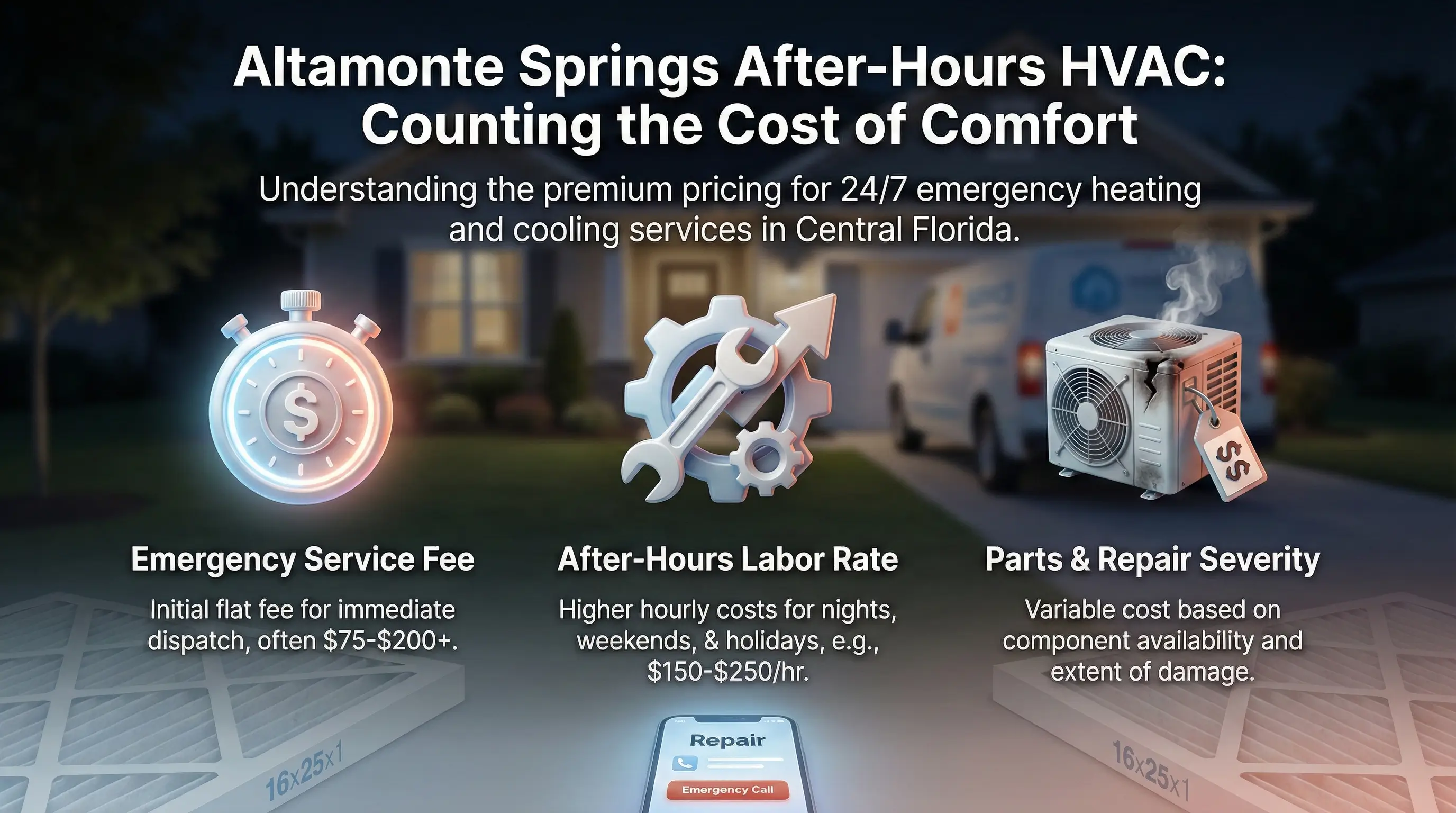
After-hours emergency rates: $150–$500 service call fee, $300–$1,500 total repair costs.
Most common local failures:
Capacitor and contactor failures ($150–$450)
Clogged condensate drains (humidity-related)
Refrigerant leaks ($400–$1,500+)
Burned-out blower motors ($400–$800)
Response times:
Same-day service: Call before noon on weekdays
Emergency dispatch: 1–3 hours regardless of time
Save money:
Wait until morning if not urgent (saves $200–$400)
Change filters every 60–90 days
Schedule annual maintenance ($89–$150)
Verify contractors:
Check license at MyFloridaLicense.com
Confirm NATE certification
Review BBB ratings before calling
Permits required for: System replacements, ductwork modifications, refrigerant line work. Not required for simple component replacements like capacitors or thermostats.
Top Takeaways
Expect $150–$500 for emergency service calls in Altamonte Springs
Total repairs typically run $300–$1,500 depending on the problem
Fair emergency rates are 50–100% above daytime pricing
Anything beyond that is exploitation
Half of midnight calls don't need emergency pricing
If you can make it until morning with fans, you'll save $300–$500
Wait for regular business hours unless health conditions make heat dangerous
One uncomfortable night beats paying premium rates unnecessarily
Eighty percent of emergencies were preventable
Change filters every 60–90 days
Schedule annual tune-ups ($89–$150)
Basic maintenance prevents most midnight failures
Find trustworthy help before you need it
Verify licensing at MyFloridaLicense.com now
Check BBB ratings for local companies
Save their number—don't Google desperately at 2 AM
Price-gouging contractors prey on panicked homeowners
Always ask about costs before technicians arrive
Get upfront service call fees
Confirm diagnostic charges separately
Understand payment terms
Legitimate companies provide clear pricing without pressure
What Counts as a True HVAC Emergency in Altamonte Springs?
Not every AC problem at 10 PM requires emergency pricing. After years serving Altamonte Springs homes, I've learned that true emergencies involve safety risks or unbearable conditions—a completely dead system during a heat advisory, refrigerant leaks, electrical burning smells, or frozen pipes threatening your home.
If your AC is running but just not cooling well, or if you hear a strange noise but the system still works, you can usually wait until morning for standard rates. I know it's uncomfortable, but fans and open windows can get you through one night and save you $200–$400 in after-hours premiums.
The exception? Homes with elderly family members, infants, or anyone with health conditions affected by heat. Your family's safety always comes first.
Breaking Down After-Hours Emergency Costs
Emergency service calls in Altamonte Springs include three cost components you'll see on any honest estimate.
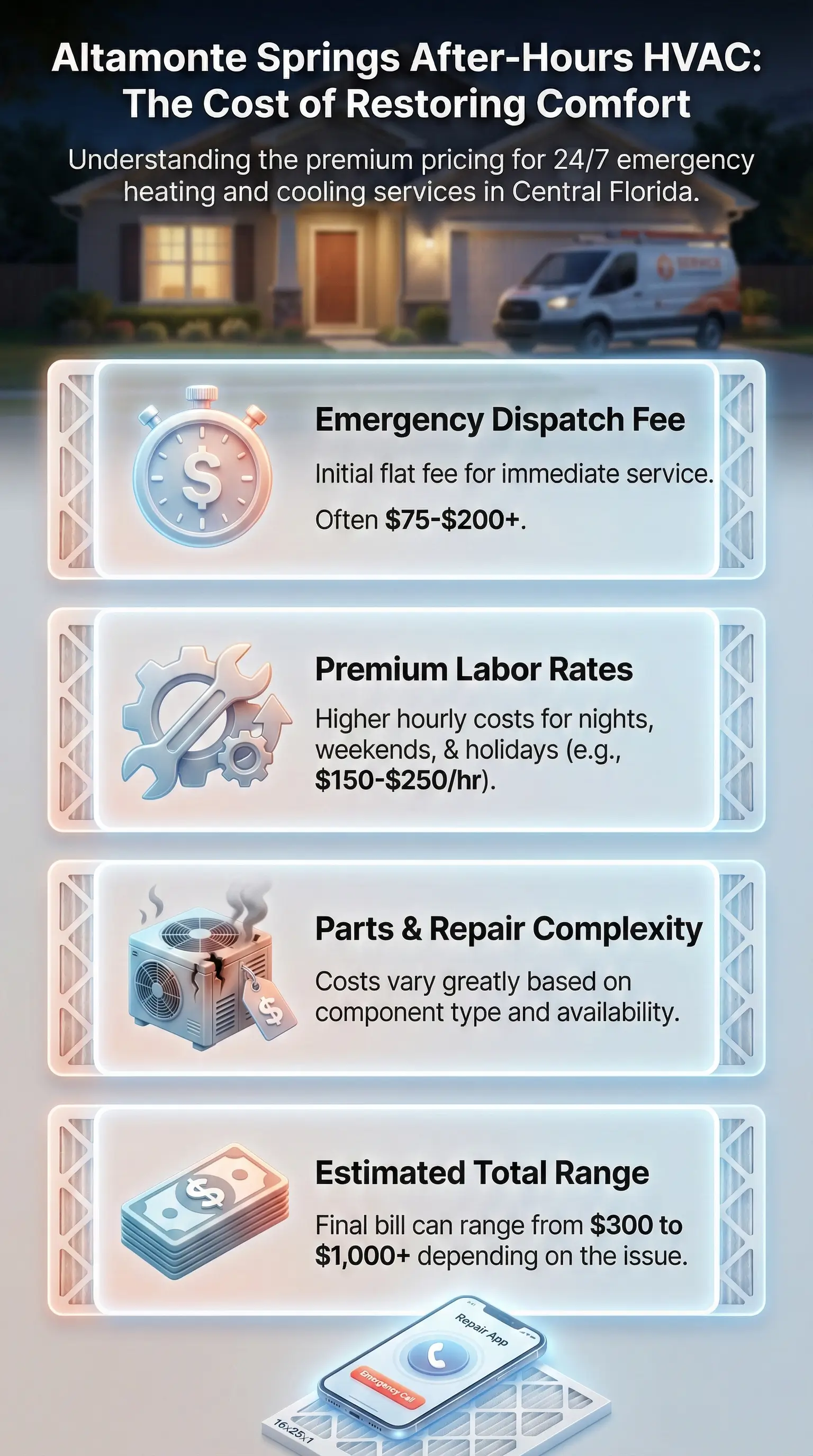
The emergency service fee ($150–$300) covers getting a technician to your door outside normal hours. Most local companies charge this whether they fix the issue or not—it's essentially a premium for immediate availability when most technicians are home with their families.
Diagnostic work ($75–$200) identifies what's wrong. Some companies waive this if you proceed with repairs, while others charge it separately. Always ask upfront.
Actual repair costs ($150–$1,200+) depend entirely on what failed. A tripped breaker or blown fuse? Maybe $150–$250. Failed capacitor? $200–$400. Compressor replacement? You're looking at $1,200–$2,500 even before the after-hours premium.
Why After-Hours Costs More (And Should)
After-hours rates run 50–100% higher than daytime service, and there's nothing shady about it. When I send technicians out at midnight, they're leaving dinner with family, missing their kids' bedtime, or cutting short their only evening off that week.
Those overtime wages, fuel costs for emergency response, and the reality that we keep parts inventory and technicians on call specifically for these moments—that's what you're paying for. It's the same reason emergency rooms cost more than scheduled doctor visits.
What shouldn't happen? Companies charging $500 just to knock on your door, or quoting $800 for a $200 part because they know you're desperate. That's not emergency pricing—that's taking advantage.
Common Altamonte Springs After-Hours Repairs and Real Costs
In our area, the most common midnight emergencies follow predictable patterns tied to how hard these systems work in Central Florida's climate.
Capacitor failures ($200–$450 after hours) happen constantly here because the heat and humidity destroy these components faster than in cooler climates. Your AC starts and stops dozens of times daily fighting our weather, and capacitors eventually give out—often right when you need the system most.
Contactor failures ($250–$500) follow the same pattern. I've replaced hundreds in Altamonte Springs homes, especially in systems over seven years old.
Refrigerant leaks ($400–$1,500+) require locating the leak, repairing it, and recharging the system. After hours, this gets expensive fast, but a completely dead system in July isn't something most families can ignore until morning.
Blower motor issues ($500–$1,200) often happen in homes where filters haven't been changed regularly. When motors work harder pushing air through clogged filters, they burn out—usually at the worst possible time.
How Time of Day Affects Your Total Bill
The difference between calling at 6 PM versus midnight can be significant. Most local companies define "after hours" as weeknights after 5 or 6 PM, but the deepest premiums hit between 10 PM and 6 AM.
Weekend emergency calls (Friday 5 PM through Monday 8 AM) typically cost more than weeknight emergencies. Holiday calls? Expect premium pricing, and honestly, you should—technicians sacrifice family time on Christmas or Thanksgiving to help you.
If your system dies at 8 PM and you can make it until 7 AM with fans and cool showers, waiting for regular business hours might save you $300–$500. But if it's genuinely unbearable or unsafe, don't suffer through the night to save money.
What Honest Local Companies Should Tell You Upfront
Before any technician touches your system, you deserve clear answers about what you're paying. Reputable Altamonte Springs HVAC companies will tell you their after-hours service call fee before dispatching a truck.
They'll explain whether diagnostic fees are separate or included, and they'll give you options. Sometimes a temporary fix gets you through the night so permanent repairs can happen at regular rates in the morning.
They'll also be honest about what you're facing. If your 18-year-old system needs a $1,800 compressor, a trustworthy technician will tell you that might not make financial sense—even if it means they don't make the repair sale that night.
What you shouldn't hear? Pressure to decide immediately, refusal to provide written estimates, or claims that prices are only good "right now." Those are red flags that you're dealing with someone who preys on desperate homeowners.
Questions to Ask Before Agreeing to After-Hours Service
When you call for emergency help, ask these specific questions before anyone drives to your home.
What exactly is your after-hours service call fee? Get a number, not a range. Is your diagnostic fee separate, and if so, how much? Will you waive it if I proceed with repairs? What forms of payment do you accept, and do you charge extra for credit cards?
Also ask: Are your technicians licensed and insured? How long have you been serving Altamonte Springs? Can you provide references from local customers?
These questions quickly separate legitimate local companies from out-of-town operators who show up in our area when they smell desperation.
When You Can Wait Until Morning (And Save Significantly)
I've talked plenty of Altamonte Springs homeowners off the ledge when they call panicked at 11 PM. If your AC stopped cooling but air is still moving, you have options.
Close blinds and curtains to block heat. Use fans strategically—a box fan in a window pulling hot air out works better than you'd think. Take cool showers before bed. Sleep in your coolest room, usually away from afternoon sun exposure.
If you're in one of Altamonte Springs' older ranch homes with good shade trees and cross-ventilation, you can often make it work overnight. The concrete block construction that's common here actually holds cool pretty well once the sun goes down.
Medical conditions change this equation entirely. Don't tough it out if anyone's health is at risk.
How to Avoid After-Hours Emergencies in the First Place
Most midnight emergencies I respond to in Altamonte Springs were preventable. Systems don't usually just die randomly—they give warning signs that get ignored until catastrophic failure happens at the worst time.
Strange noises, weak airflow, short cycling (turning on and off rapidly), or ice forming on your outdoor unit—these are problems crying out for attention before they become 2 AM emergencies.
Regular maintenance catches most issues before they become crises. Changing filters every 60–90 days (more often if you have pets) prevents the majority of blower motor failures I see. Keeping your outdoor unit clear of debris and vegetation prevents overheating issues.
An annual tune-up before summer hits—typically $89–$150 locally—identifies failing capacitors, weak contactors, and refrigerant issues while they're still minor repairs during business hours.
What to Do Right Now If Your System Just Failed
First, check your thermostat batteries and settings—you'd be surprised how often "broken" systems just need fresh batteries or got accidentally switched to "heat" mode.
Check your circuit breaker panel. AC systems have dedicated breakers, usually 30–60 amps. If it's tripped, try resetting it once. If it trips again immediately, you have a real problem—don't keep resetting it.
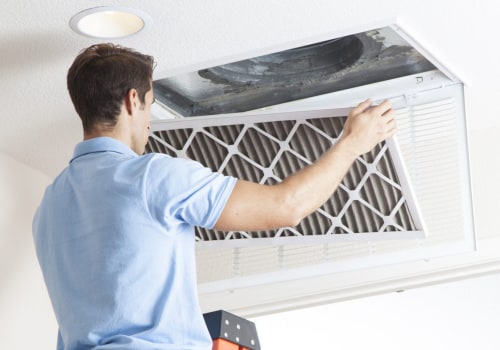
Check your air filter. A completely clogged filter can cause systems to shut down as a safety measure. If it's filthy, replacing it might get you running again.
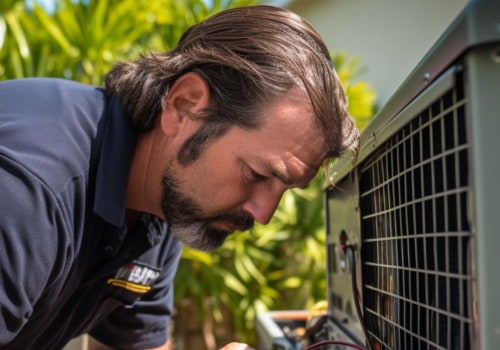
Look at your outdoor unit. Is it completely silent with no fan movement? That's different from a fan running but no cool air, which points to different problems.
These simple checks sometimes solve the issue or at least give technicians helpful information when you call, potentially saving diagnostic time and money.
"After two decades serving Altamonte Springs, I can tell you that half the panicked midnight calls I get don't actually need emergency pricing—and I'd rather help a neighbor make it through the night safely and save $400 than pressure them into repairs that could wait until morning."
Essential Resources Before Hiring Emergency HVAC Help in Altamonte Springs
Verify Your Contractor Is Actually Licensed in Florida
Before letting anyone touch your system at 2 AM, check their credentials at https://www.myfloridalicense.com/intentions2.asp—it takes 30 seconds and protects you from unlicensed operators who show up in our area when homeowners are desperate. I've seen too many neighbors get burned by "technicians" with fake credentials, and this official state database shows current licenses, complaint histories, and insurance coverage for every legitimate contractor.
Research Company Reputation and Complaint History
When you're panicking at midnight, it's tempting to call the first number you find, but spending three minutes checking the Better Business Bureau at https://www.bbb.org/us/fl/altamonte-springs can save you from price-gouging contractors. After years in this community, I know which local companies treat neighbors fairly and which ones prey on emergency situations—this database reveals patterns you need to see.
Understand Current HVAC Efficiency Standards and Tax Credits
If your emergency reveals your system should be replaced rather than repaired, knowing current efficiency standards at https://www.energystar.gov/products/heating_cooling helps you make smart decisions under pressure. I walk homeowners through these choices regularly, and understanding what qualifies for federal tax credits means you won't overpay or accept outdated equipment just because you needed help fast.
Find Available Utility Rebates That Offset Repair Costs
Living here myself, I know Orlando Utilities Commission offers rebates at https://www.ouc.com/rebates that can reduce emergency replacement costs by hundreds of dollars for Altamonte Springs residents in their service area. Many homeowners don't realize these exist until after they've already paid full price—checking before you commit to major work just makes financial sense.
Confirm Your Technician Holds Proper Industry Certifications
Verify NATE certification at https://www.natex.org/verify-certification before authorizing expensive repairs, because this credential proves actual competency beyond basic state licensing. In my experience, NATE-certified technicians consistently deliver better diagnostics and longer-lasting repairs—it's the difference between someone who truly knows HVAC systems and someone who just passed a basic test.
Know Which Repairs Require Building Permits Locally
Check Seminole County permit requirements at https://www.seminolecountyfl.gov/departments-services/community-services/building-development/building-division/ before approving major work, because contractors who skip permits are cutting corners that could affect your insurance and home value. Honest local companies pull required permits automatically—if someone suggests skipping this step to "save money," that's a red flag you're dealing with the wrong contractor.
Access Unbiased Consumer Information on HVAC Systems
Review independent guidance from the U.S. Department of Energy at https://www.energy.gov/energysaver/home-heating-systems when you need objective information without sales pressure. After helping Altamonte Springs homeowners through countless emergency decisions, I recommend reading this federal resource before accepting any contractor's recommendation about whether to repair or replace—it gives you the knowledge to evaluate advice from a position of understanding rather than panic.
Supporting Statistics on HVAC Emergencies and Repair Costs
Most Failures Happen During Peak Demand
The U.S. Department of Energy confirms at https://www.energy.gov/energyexplainer/air-conditioning that 75% of HVAC failures occur during extreme weather when systems work hardest.
What I see in Altamonte Springs:
Most emergency calls happen late July through mid-September
Systems fail after months of nonstop operation fighting our heat
Breakdowns typically occur on the hottest days or stuffiest nights
Components surrender to stress exactly when you need them most
Florida Cooling Costs Exceed National Averages Significantly
The U.S. Energy Information Administration reports at https://www.eia.gov/energyexplained/use-of-energy/homes.php that AC represents 12% of home energy costs nationally.
Local reality is different:
Altamonte Springs homeowners spend 20–25% or more on cooling
We cool year-round, not seasonally like most of the country
Your AC is your most critical home comfort system here
It runs nearly every day, making emergency repairs feel more urgent
Eighty Percent of Emergencies Were Preventable
ASHRAE research at https://www.ashrae.org shows inadequate maintenance causes 80% of premature HVAC failures.
What I find at midnight emergency calls:
Filters unchanged for a year or longer
Outdoor coils caked with dirt and debris
Warning signs ignored for months before catastrophic failure
"Emergencies" that were actually predictable breakdowns waiting to happen
Final Thought & Opinion: What Emergency Pricing Really Means
After-hours emergency HVAC repair in Altamonte Springs costs more because it should—technicians deserve fair compensation for leaving their families at midnight to help yours. Expect $150–$500 for emergency service calls and $300–$1,500 total depending on what failed and when you need help.
Understanding Fair vs. Exploitative Pricing
Here's what bothers me after years in this business:
Legitimate emergency rates run 50–100% above daytime pricing
Fair after-hours service reflects real costs and technician sacrifice
$500 just to knock on your door isn't emergency pricing—it's exploitation
$800 quotes for $200 parts prey on desperate homeowners
Half These "Emergencies" Can Wait Until Morning
The honest truth from someone who takes these calls:
Many panicked midnight calls don't actually need emergency rates
If you can safely make it until 7 AM with fans and windows, you'll save $300–$500
I'd rather help you through one uncomfortable night than pressure unnecessary premium pricing
Medical conditions change this equation—family safety always comes first
Most Emergencies Were Completely Preventable
What frustrates me at 2 AM emergency calls:
Systems failed because filters weren't changed in 18 months
Outdoor units choked with debris gave warning signs for months
$1,200 midnight repairs could have been $300 daytime fixes
Homeowners paying emergency rates for ignored maintenance
Protect Yourself Before You Need Emergency Help
My advice after serving Altamonte Springs for years:
Find a trustworthy local HVAC company now, before emergencies happen
Schedule annual maintenance before summer hits ($89–$150 prevents costly failures)
Change filters every 60–90 days—set phone reminders if needed
Learn what your healthy system sounds like so you recognize changes
Keep your trusted technician's number saved—don't Google desperately at midnight
These simple steps mean you'll rarely face true emergencies. And when you do, you'll have honest help already lined up instead of hoping whoever answers at 2 AM won't take advantage of your situation.
FAQ on HVAC Repair in Altamonte Springs
Q: What's the average cost for regular HVAC repair in Altamonte Springs during business hours?
A: Standard repairs during business hours run $150–$800 depending on what failed.
Common repair costs:
Capacitors or thermostats: $150–$300
Blower motors or complex repairs: $400–$800
After-hours premiums add $200–$400 to these prices for identical work
If your system dies at 9 PM but isn't a safety hazard, waiting until 8 AM saves significant money.
Q: How quickly can I get same-day HVAC repair in Altamonte Springs?
A: Call before noon on weekdays and most local companies offer same-day service.
Response times vary by season:
April or October (moderate demand): 2–4 hours typical
Late July or August (peak season): 6–8 hours even for same-day
True emergencies: 1–3 hours dispatch regardless of season
Every technician in Altamonte Springs runs flat-out during summer peaks.
Q: What HVAC problems are most common in Altamonte Springs homes?
A: After servicing hundreds of homes here, I see the same climate-related failures repeatedly.
Most frequent issues:
Capacitor and contactor failures from constant cycling in heat and humidity
Clogged condensate drains from gallons of daily moisture
Refrigerant leaks in systems working overtime year-round
Burned-out blower motors in homes not changing filters every 60–90 days
These aren't random—they're tied directly to Central Florida's brutal climate.
Q: Do I need permits for HVAC repairs in Altamonte Springs?
A: Simple repairs don't require permits. Major work does.
No permit needed:
Capacitor replacements
Contactor replacements
Thermostat changes
Permit required:
Ductwork modifications
Refrigerant line work
Electrical upgrades
Complete system replacements
Honest contractors pull Seminole County permits automatically and include costs upfront. If someone suggests skipping permits to "save money," that's a red flag for cut corners that can void your homeowner's insurance.
Q: How do I verify an HVAC contractor is licensed in Altamonte Springs?
A: Check MyFloridaLicense.com before anyone touches your system—takes 30 seconds.
What you'll see:
Current license status
Complaint history
Disciplinary actions
Proof of insurance
Unlicensed operators flood Altamonte Springs every summer when demand spikes. Every legitimate Florida HVAC contractor has a state license number they should provide without hesitation.
Don't Face Your Next HVAC Emergency Alone—Get Local Help You Can Trust
Now that you understand fair emergency pricing in Altamonte Springs, save our number before you need it: we're your neighbors who happen to be HVAC experts, available 24/7 when your system fails and ready to give you honest advice even if that means telling you to wait until morning. Contact Filterbuy HVAC Solutions today for a free maintenance consultation that could prevent your next midnight emergency—because the best time to find trustworthy help is before you're desperate at 2 AM.
Learn more about HVAC Care from one of our HVAC solutions branches…
Filterbuy HVAC Solutions - West Palm Beach FL
1655 Palm Beach Lakes Blvd., Ste 1005 West Palm Beach, FL 33401
(561) 448-3760
https://maps.app.goo.gl/VarpgNZnxuPQuW8A7